


The best time to sell your Renton home is the point where your house, your finances and the current buyer pool line up. The calendar matters, but it is only one part of the decision.
Sellers often ask whether they should wait for spring. Spring can be excellent, but “list in April” is not a complete strategy. A well-prepared home launched in February can outperform a rushed home launched in May. A distinctive home may benefit from peak buyer traffic; another may stand out more when competing inventory is lower.
Here is how I think about timing in Renton.
First: what is the 2026 market telling us?
The August 2026 Renton market snapshot shows a market with more inventory and longer market times, giving buyers more options while making thoughtful pricing and presentation increasingly important for sellers. Conditions also vary across Renton’s ZIP codes and between residential homes and condominiums.
That local variation matters. A Kennydale view home, a Highlands townhome and a Benson Hill rambler can experience the same market very differently. The snapshot below provides a closer look at recent activity across Renton, including median sales prices, closed sales, days on market, new listings and available inventory.
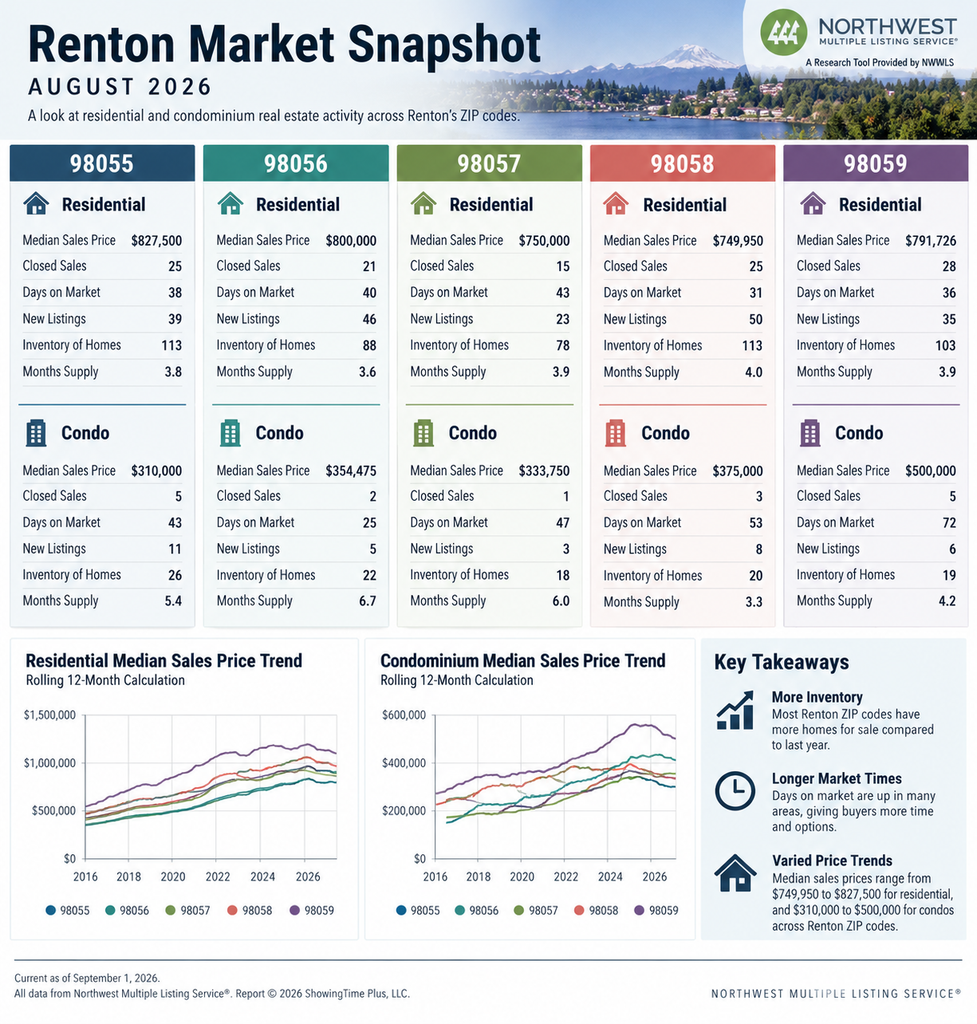
Source: Northwest Multiple Listing Service. Information and statistics compiled and reported by the Northwest Multiple Listing Service.
For sellers, the practical takeaway is that timing is only one part of the equation. Correct pricing, strong presentation and a clear launch plan can matter just as much when your home is competing for buyer attention.
What each season can offer a Renton seller

January and February: less competition, motivated buyers
The year often begins with fewer listings. Buyers shopping this early may have a job change, lease deadline, relocation, rate opportunity or other reason to act.
Potential advantages:
- Fewer competing homes
- Serious buyers already watching
- A head start before the spring listing wave
- Strong opportunity for homes that show well in winter
Potential tradeoffs:
- Shorter daylight
- Weather can make exterior photography and landscaping harder
- The buyer pool may be smaller than in spring
This timing can work well when the home is ready and the property still presents attractively in winter.
March through May: the traditional spring market
Spring usually brings more buyers, more listings and stronger visual appeal as landscaping wakes up. It is popular for a reason.
Potential advantages:
- Larger pool of active buyers
- More daylight for showings
- Yards and outdoor spaces begin to shine
- Buyers aiming for a summer move often enter the market
Potential tradeoffs:
- More competition
- Buyers can compare your home with several alternatives
- Rushed preparation is more obvious
- Pricing too aggressively can cost the most valuable launch window
Spring is not automatically forgiving. When inventory grows, buyers reward the homes that feel ready.
June through August: long days and move-friendly timing
Summer can be useful for buyers coordinating a move around travel, work or a school-year calendar. Outdoor areas are easy to showcase, and evening showings benefit from the light.
Potential advantages:
- Excellent photography and curb appeal
- Patios, gardens and views can be experienced fully
- Flexible showing windows
- Some buyers have a firm timeline
Potential tradeoffs:
- Vacations can interrupt traffic
- More listings may be competing
- Heat or dry landscaping can affect presentation
- A home that missed its spring price can look stale by midsummer
A strong summer launch needs a specific plan for the first seven to ten days.
September and October: focused buyers and a reset
Early fall can be an underrated window. Some spring and summer listings have sold or come off the market, while buyers who still need a home remain active.
Potential advantages:
- Less noise than peak spring
- Attractive seasonal light and landscaping
- Buyers may be more decisive
- Opportunity to relaunch the story of the home
Potential tradeoffs:
- Daylight begins to shrink
- Weather becomes less predictable
- Overpricing can consume the remaining fall window quickly
Fall works best when we enter with discipline instead of “trying a number” and planning to adjust later.
November and December: smaller audience, lower competition
Holiday-season buyers are often shopping for a specific reason. There may be fewer of them, but there may also be fewer comparable homes.
Potential advantages:
- Less competition
- Serious buyer intent
- Warm, inviting presentation can work beautifully
- Timing may fit tax, relocation or personal goals
Potential tradeoffs:
- Holiday schedules limit access
- Photography and exterior presentation can be challenging
- Some buyers pause until January
Selling during the holidays is possible; it simply requires realistic expectations and a showing plan that protects both momentum and your life.
Readiness can matter more than the month

Before choosing a date, I evaluate four kinds of readiness.
1. Property readiness
Can we complete the improvements that will materially change a buyer’s first impression? That does not mean remodeling everything. It means resolving distracting repairs, editing belongings, cleaning deeply and showing the home’s best features.
Start with the room-by-room listing photo checklist and decide what truly needs to happen before photography.
2. Pricing readiness
Do we understand the current competition, not only past sales? Closed sales tell us where the market has been. Active and pending listings help show what buyers can choose now and what they are responding to.
The right list price should account for:
- Recent comparable sales
- Current competing listings
- Condition and updates
- Layout, lot, parking and location
- View, privacy and outdoor usability
- Interest-rate and inventory conditions
- The likely buyer for this particular home
3. Personal readiness
What happens after the sale? Your timing may depend on a purchase, move, job, family transition, tenancy, tax question or need for flexibility.
A slightly stronger seasonal market may not be worth forcing a timeline that creates unnecessary cost or stress.
4. Launch readiness
The first days on market are not a rehearsal. Before going live, we should have:
- Final pricing and positioning
- Professional photography
- Complete listing copy and disclosures
- Showing instructions
- A distribution plan
- A feedback and adjustment schedule
- Clear decisions about what we will do if the market does not respond
A simple decision framework
Ask yourself these questions:
- If I sold in the next 60 days, where would I go?
- What work would I need to finish before photos?
- What sale proceeds do I actually need, not just the headline price?
- How much uncertainty can I tolerate?
- What are comparable Renton homes doing right now?
- Would waiting improve my position, or only delay the same preparation?
The answer may point to listing now, preparing now for a later launch, or waiting with a specific trigger rather than an open-ended “someday.”
My honest answer to “When should I list?”
List when we can make the home compelling for the buyers who are active in that season.
If your home is ready in late winter and comparable inventory is thin, waiting for spring may create more competition. If your landscaping is a major selling feature and needs six weeks to look its best, that may be worth planning around. If you need certainty before buying your next home, the contract strategy may matter more than the month.
There is no universal best date. There is a best strategy for your property and your next move.
Want a selling timeline built around your actual home? Request a Selling Strategy Session. I will give you a value range, recommended preparation list, likely buyer profile and the strongest realistic launch windows.
Leave a Reply